Thursday, 20 May 2021

Dungeons & Dragons: Candlekeep Mysteries Review

Review copy courtesy of Wizards of the Coast.


Pros

  • The layout of this book is really solid. It starts with background knowledge for the setting of Candlekeep itself, and then branches into many short adventures. The tips and organization is also well done, making it easier to understand than many other adventure books in this edition.

  • There’s a total of 17 adventures between level 1 and 16.

  • More full cover art. It’s a highlight of this edition, and keep it coming. And with more realistic pictures please.

  • The adventure provides advice on certain elements of the adventure that can be changed, as well as alternate locations if you don’t play in Candlekeep or the Forgotten Realms.

  • More maps, and these have colour. As the book says itself, “a good map is all a Dungeon Master needs”. Well, roughly.

  • It has that balance between a little bit of setting building for Candlekeep, but also the main meat is the adventures. I’ve felt for a while that these books are strongest when it can act as part setting book, part adventure, part spare parts to steal from, and inspiration.

  • Tear away map of Candlekeep is also provided. I loved when this started with Curse of Strahd, and I hope they continue with it going forward.


Could Go Either Way

  • The adventures themselves are on the short side at 10-15 pages long. From my experience this translates to around 2.5 hours on the low end, and 5 hours on the high end. This is influenced by play style, since it's been my experience that treating the adventure as a dungeon delve shortens the time. This estimate is also for the content in the book. There are situations where rooms can be avoided, and many adventures leave hooks for adding more adventure of your own making. However, this shorter length also makes it easy to drop into your own campaigns as the occasional side quest.

  • The adventures don’t really fit together, except for the central framing device of being discovered from the books of Candlekeep (or other library).

  • It’s still a little on the short side, but longer than some others.

Cons

  • The vast majority of the maps are not coloured. For an expensive book like this, I’d want colour. That said, you might find some of these easier to use and modify on the fly as thet don't have interiors detailed. However, most do have them detailed. You might also prefer the art style.

  • Keep an eye on the book quality. My standard copy had the last 6 pages with torn corners.

  • A few issues with wording. The second adventure has this, where one section says a character is willing to give books as reparations, but a later section makes it sound like they’ll only do so if they get something in return. Meenlocks already have some interesting quirks due to their descriptions. Since they paralyze for up to a minute, they probably need to beat their target unconscious (for adventurers, probably this one), steal them in their sleep, or sneak up while they sleep. This means that after an hour, the affected character is turned? An example of such a scenario would go a long way to making it more clear. Of course, this issue exists from the book meenlocks were first included.

  • No PDF*


* Denotes nitpicking.

Candlekeep Mysteries Cover
Cover for Candlekeep Mysteries.


Introduction

We’ve had a lot of big adventures in this edition of D&D. We’ve also had a few smaller ones, but they usually came as an optional starting point to a bigger adventure, or from magazine material. Here we have multiple smaller adventures that are connected through the framing of Candlekeep, the legendary library in the Forgotten Realms. However, if you have your own settings it can also work in those. All you need is a library in your world, so the books can lead the adventure! And since they are bite sized adventures, you can use as many or little as you want. Or change them to suit your taste. At the time of writing I have run the first 4 adventures, and the first 2 adventures for two separate groups. I've also read the book from beginning to end.


What do I think of it? Well, the organization is probably among my favourites. And I really actually like this concept. I hope they do more of these anthologies for different locations and settings. Why not a Ravenloft one? Or Spelljammer? Or Planescape? The adventures themselves are solid. I just wish they were more variety in length. Maybe some double length features with that noted? That way there’s more variety of complexity. So with that, let’s jump into the specifics.

The alternate cover for Candlekeep Mysteries. I really like this one.


The Adventure

New Player Options

Nothing here. It’s all about the adventure.


New Monsters

Almost nothing here. The majority of monsters from the Monster Manual or standard rules such as the Monster Manual and basic rules/SRD. There are a few extras though. The Lichen Lich is a good example. These are all included in the adventure itself. The previously named example is a favourite of mine. It should be easy to tell that undead are my favourite type of enemy, so a new type that also combined the fungus of one of my favourite Demon Lords is something I’m happy to see. A swam of books is also here, challenging or annoying low level characters. There are also others. So in general there’s not much, but there’s more than I expected. Also be aware that some of the new monsters are from other books, but are included since they’re not in the Monster Manual.


What You Need to Play

The Monster Manual, Player's Handbook and Dungeon Master's Guide are referenced at the start of the adventure. As usual, the SRD will get you most of the way, but having all the books really helps out a lot.


The Adventures Themselves

The adventures in this book are all short adventures that can be dropped into a campaign as side quests. They’re about 10-15 pages long, and cover the level range from Level 1 to Level 15. The book jumps right into them after introducing us to Candlekeep, and doesn’t let up until the end. Each adventure is also standalone. There are sometimes suggestions about things that can be done in order to tie the adventure into your overarching story. However, they don’t reference each other. It’s best to think of this as a D&D anthology, all tied together through the setting of Candlekeep. They all don’t take place in Candlekeep, but they all do start from there and involve a book. 


They often include new dungeons and locations to visit, which also means new maps. I have a critique in the next section of the maps themselves, but they’re appreciated to help run the adventures. These dungeons touch on combat as well as exploration, which are signs of good quest design. There are often little puzzles or twists to keep it from simply being a dungeon delve. Getting from Candlekeep or the book in question is also addressed in the adventures, and can easily be adapted to other settings. In fact, the book itself suggests some alternate settings. The other thing this means, is that not all of the adventures could actually be set in Candlekeep itself. If that’s what you expected, this isn’t it. Instead, it serves as the starting point of the adventure.


The adventures are not a matter of using combat prowess to have players slaughter their way through a dungeon. Well, there’s some of that too. But there’s also conversation and friendly characters to interact with. So they generally cater to the different pillars of D&D and thought out. As they should in my opinion, since the clever character interactions and role-play are a big reason I enjoy these sorts of games.


The first adventure is particularly nice. It hits my sensibilities, and it’s something I would run for my players if my campaign was set in the Forgotten Realms. Not for every group, but if the opportunity showed itself. And I did run it for some new players. There’s a little combat, there’s a good hook, and there’s a puzzle and interaction. This sort of structure continues in the other adventures. Some can be finished without as much combat as you might expect, and role-play opportunities and creativity show. And there is some good variety. The amount of combat, the nature of the dungeon, and even the outcomes and rewards can vary widely both depending on the adventure, and the approach taken. 


Sometimes there are wording issues though. The second adventure has one pretty major one. One section says a character is willing to give books as reparations, but a later section makes it sound like they’ll only do so if they get something in return. I’m quite sure the intent was to make players provide some form of trade or help for the books in question, but it really should’ve been clear in both sections. I’d also mention this as general advice. Make sure different sections don’t say different things. Even similar but different things can be confusing, and take more time to try to decode the intent than should be required. Another issue is due to an existing monster, the meenlock. In this case this is a pre-existing confusion, but the adventure doesn’t make things as clear as it could. They have an ability to turn people into one of them by psychic torturing them. Hit 0 HP with torture? We got another meenlock. However, their paralysis lasts for a minute maximum, so the meenlock needs to beat them unconscious. Does a player get turned right after the first amount of damage? I think so as written, but an example would go a long way to clearing this up, especially for new players. How would it work otherwise? Sneaking to a character’s bedroom and torturing them as they slept, or stealing them as they slept. Still, these pale in comparison to some of the things Dungeon Masters need to untangled in the longer adventures.


These adventures due to their size, and the formatting, are probably some of the easiest to run in this edition outside of the starter sets. That said, they will still require some thought and planning. There are multiple ways some adventures can go, and some provide multiple options for the Dungeon Master to customize the adventure. Though these options are often clearly laid out with examples the Dungeon Master can quickly choose from. This makes the process far smoother than many others, though there will still be situations out of the box. The previously mentioned example of trading help for books? The kind of help that’ll be accepted isn’t specified. So you’ll need to use your Dungeon Master muscles. And due to their smaller size, it also makes them easy to change without unintended consequences 100 pages in. This is probably among the more versatile and easiest to re-use books in a long while, and I hope to see more in this style.


The Art and Book Build Quality

The art is what we’ve come to expect. I’ve said this many times, but it’s a good thing. Since it means these books are consistent in their presentation, and quality. In particular, this book has great environmental art in multiple places. The art with the ghostly dragon trapped in the lower area of Candlekeep is a particular highlight. The framing devise of these adventures all involve a book, and the books that kick off the adventures are all illustrated in colour. I really liked this too. The tear-away map is also like we’ve come to expect. It’s in the same art style, large, and full colour. The standard cover is solid, but not my favourite of this edition, or even the last few books. Rime of the Frostmaiden looked far better to me. The other cover though? I really like it. They keep the stylized design with high contrast, which gives it that old book appearance. 


So what didn’t I like? Well, the maps. Many of them are not coloured. They’re the simple style maps you’d be used to seeing in older adventures, where it’s just line colour. It’s functional, and you can still have fun with it. But with the price of these books, I want to see them all coloured. Not all of the maps are like this though. It’s usually the dungeon maps. The overland maps are beautifully coloured like I’d expect.


My standard copy also had torn corners for the last 6 pages. It was barely noticeable at first, but less than ideal. The better the initial condition, the better the books last. So as previously recommended, if you can take a look at the book for quality issues. That said, with the current global pandemic, you probably won’t have that luxury.


Price

It’s the standard $49.99 USD MSRP we’ve come to expect. Check here for more info.


What I felt was Missing

As previously mentioned, the maps aren’t in colour. That really would’ve went a long way to helping the presentation. And I think it leaves a bigger impression with players. Otherwise, more variety would’ve been nice. All of the adventures here are about 10-14 pages long. As an anthology, I’d have liked to see some longer ones, and shorter ones. 


I’d have also liked to see another 2-3 adventures, so that the book was around the 250 page mark. Around there is where I think the books should aim for at their given price point. Though with sales, they’re often still worth a buy.


I mentioned this before, but for creatures such as meenlocks some examples of play would go a long way to help. So that way they can see the mechanics as intended, since the abilities and how it interacts with combat can be tricky. Is it intended to turn a player into a meenlock in an hour because they’re already at 0 hit points? I’d say yes as written, but an example would make it undisputedly clear.


Free Stuff

Nothing to see here.


Summary

I really like this book. And I like this concept of D&D anthology collection. We’ve had many adventures in the Forgotten Realms, and it remains a popular setting. So having small side quests that can be dropped into existing games while using Candlekeep as a starting point is extremely useful. Though if that’s not your setting, they can be placed into a different library fairly easily. The quests themselves are also interesting, having new maps, locations, combat, and also character interactions. They’re all 10-15 pages long, which is on the short side. This is a strength, as it makes for easy side quests. But it’s also a weakness, as I’d liked to have seen more variety in length and complexity. Most maps not being colour is also a disappointment for me. I’d also liked to have seen a couple more adventures included, to increase the page count. If this description sounds interesting to you, I think you’ll enjoy it. And I hope to see more settings and locations in the future. Maybe even coinciding with new large adventures as they’re released.

Sunday, 11 April 2021

Tasha's Cauldron of Everything Review

Review copy courtesy of Wizards of the Coast.


Pros

  • Lots of full colour art (as we have come to expect of this edition). Really, keep this coming.

  • The puzzle section is well done. Actually, can we get an addition Dungeon Master’s Guide with extra traps, maps, items, and puzzles like this?

  • The patron section is also well done. What this does is provide more information for making quest givers and patrons for the party. This is particularly useful for new players, since more experienced ones would come up with this naturally.

  • The idea of the sidekicks section is also nice. It’s a form of non player character that can join a party, and is specifically made to be easier to play than normal. I like this idea, and it provides some mechanics out of the box for giving your fighter that squire they always wanted. And how to level them up. It’s easy enough getting them a guard, but harder to find a balanced way to have them level up with the party. There is one caveat I’d add. See the cons section.


Could Go Either Way

  • Class options in might not be well liked, by Dungeon Masters in particular. Some seem to make previous options look more useless, and don’t provide fixes to existing ones. Rangers in particular get the worst of this treatment.

  • This book is rather short. At 192 pages long, I wish it was longer.

Cons

  • The sidekicks made using the rules provided seem to be significantly weaker than a normal player class. This is in theory fine, since you might not want them to outshine the main characters. Well, except it also mentions some players could prefer playing the simplified character. In this case, the player could feel significantly weaker later in the campaign and may need to swap to a full character class later. Regardless, they are treated like a character for calculating encounter difficulty... which doesn’t seem right especially at higher levels. It’d probably be fine if there’s not many in the party, but if every player has one I imagine it’d throw off the calculation heavily.

  • No PDF*


* Denotes nitpicking.


Tasha's Cauldron of Everything Standard Cover
The standard cover for Tasha's Cauldron of Everything.
Tasha's Cauldron of Everything Standard Cover
The alternative cover for Tasha's Cauldron of Everything.


Introduction

So, I’ve got a bit behind with these. To catch up I’m going to try to do a shorter format for some books. I may also bring this format back for books that I have less to say about. That said, I do expect to go back to normal some time in the future. The way I’d describe Tasha’s Cauldron of Everything is as part a Players Handbook Addition, and as part a Dungeon Master’s Guide addition. The new class options play to the players side of the screen along with the new spells, and the new items, sidekicks rules, help on social contracts and session 0, negotiating with creatures, magical phenomenon, natural hazards, and puzzles all play to the Dungeon Master’s side. So what do I think?


New Player Options

Just over 1/3rd of the book is dedicated to new sub classes for existing player classes and new player class (artificer). I generally think this is the weakest part of the book. Part of it is I don’t think they’ve balanced new options and even some of the old ones as well as they could have, or should have. Also for my own sanity I typically make players consult with me for any options outside the Player’s Handbook. However, there’s also another 12 pages of new spells, which I’m more happy to see. This is because they’re easily limited, and also give the Dungeon Master more options to play with. After all, our enemies don’t have to be perfectly balanced one on one to be part of an engaging encounter.


New Dungeon Master Options

This is where the book really excels. As previously mentioned it includes new items, sidekicks rules, help on social contracts and session 0, negotiating with creatures, magical phenomenon, natural hazards, and puzzles. Just over half the book is dedicated to these.


Of particular note is the sidekick rules. I love the idea, and I think we’ve all at one point or another given the players an NPC that will travel with them. I also like that it allows a new Dungeon Master to quickly have stats at the ready for a new ally. It also allows each player to have two characters, one less complex than the other as not to outshine their main character. What I don’t like is how this ties into encounter design. They’re treated as full player characters, but in terms of pure combat prowess they really don’t match up past level 1. This is seen most obviously at level 20, where they have a 5th level spell at most. Yes, some classes follow a similar progression, but they get other abilities in return. That doesn’t really happen here. The more such characters are in an encounter, the worse the problem becomes. One probably won’t affect the balance too much unless the encounter is already balanced on a knife’s edge. However, if half the party is? I think they’d feel it.


The puzzles are also a nice touch. I also like how they take the time to mention ways to customize the puzzles. This helps with both fitting into the theme, and even though it may seem obvious such options can be easily missed. The ways to customize the puzzle also sometimes mention ways to increase the difficulty of the puzzle, which again is very helpful. Handouts are also provided to make them easier to run. Honestly, I wouldn’t mind if they had a book in the future that is just half full of puzzles.


The magic items are well illustrated, and interesting ones are included. Again I wish there were more. However, I also wish they stopped adding items that increases a spell’s DC. Spells can already target a creature’s weak stats, and there aren’t as many ways to raise DC resistance as armour class. Previously, very early in the edition, magic items would increase the to hit of spell attack rolls, but raising DC was not done.


The other options tend to be on the smaller side, but they’re also welcome. They also don’t overstay their welcome, but are interest reads and the sort of inspiration I hope to find in books targeting Dungeon Masters. The exception is that the social contracts and session 0 sections probably won’t have much for more experienced Dungeon Masters. Really, I do wish there was more.


The Art and Book Build Quality

The high quality and quantity of art remains. My complains about maps being black and white are also not present, as no maps are included. I still wish more of the art was in my preferred realistic style, but that’s also consistent from other books. The covers are still great, and the quality of my books was good as well. The quantity also there, with many of the items having their own illustration. However, as always, if you’re in the store make sure to check for damage and to ensure the book has a good binding. If you’re ordering online, you won’t have the same chance.


Price

As usual the price is $49.95 in the States. You can check the MRSP here, or your local game store. They could have a deal. I do think this one is on the short side unfortunately. I wish they went back to the length of the core books.


What I felt was Missing

Some sort of new maps would’ve been nice. I always appreciate them as a Dungeon Master. The part about customizing spells should really be added to the basic rules, and/or new editions of the Player’s Handbook. It’s short enough to fit, but powerful enough that I think new players and Dungeon Masters could benefit.


Free Stuff

Nothing to see here.


Summary

In general what’s here for the Dungeon Master’s side of the screen is solid. I like what there is. And even if I won’t use the tables for natural hazards, I can still use the rules provided for events such as avalanches. Really, I just wish there were more events, more puzzles, more magical phenomenon, and more in general. That probably speaks to how much I liked that section. It’s almost like a light addition to the Dungeon Master’s Guide. I say light as that was a 300+ page tome. That said, I’m less wowed by the new class options. Though this remains consistent with my previous opinion of new class and subclass options in other books. If you liked additional options provided in previous books, you might like this too. It's a bit more extreme in the power department than some of the earlier ones in my opinion. Other than that, it’ll come down to the price vs. the page count and content.

Friday, 2 April 2021

Dungeon Master's Screen Wilderness Kit Review

Review copy courtesy of Wizards of the Coast.


Pros

  • The art on the outside of the screen is really gorgeous.

  • Having rules within a screen like this is extremely useful during play. Many people build their own screens for this reason.

  • Some of the cards are exceptionally useful. They cover things such as conditions, and even some healing potions.


Could Go Either Way

  • The interior of the screen is basically the same as the ones previously released, including the art on it for conditions, which are also found in the Player’s Handbook.

  • The cards provided come in perforated pages you need to break. This isn’t the same kind of cards some of the previous card packs provided. The addition is nice, but you may want a better material.

  • The normal price could be a bit steep, especially since many people made their own custom screens by now.

  • It’s a Wilderness set. I’d have liked a large map for forest battles, and maybe another environment on the other side (maybe snow). This sort of thing is more useful to me than pages from the rule book, and infinitely re-usable. This is especially true if the map is big enough so you can start in a different area.

Cons

  • The box to keep the extras inside seems really flimsy. I wish they’d be some better way to keep them together provided.

Dungeon Master's Screen Wilderness
Contents of package. Not a bad package at all.


Introduction

And so we have another screen product for this edition of D&D. There is value in a good D&D screen when playing in person (remember what that was like?), and I personally like to see more experimentation. Here, we see this in the form of additional goodies thrown in like status cards, item cards, and a hex page for overland travel. As the name suggests, wilderness and travel are aims of this product. It’s hoped all of this combined helps out in these areas of play. Does it? Yeah, it’s better in this regard than the previous one I looked at. However, it’s not without it’s problems. So let’s jump into the specifics.


The Screen Itself

I’ll go into this more, but the art here is a real standout. The outside of the screen looks very impressive. The inside of the screen has tables and rules ready to be referenced. It contains conditions like the screen from the core rules gift set, but the actions in combat have been removed. In their place are rules for travel, foraging, tracking, prices for services including travelling and lodging, weather, tables for damage by level range and DCs, object DCs and hitpoints, skills and associated abilities, extreme weather (cold, heat, wind), exhaustion, spell concentration, suffocating, jumping, light by light source, visibility depending on time of day, obscuring rules, cover, and encounter distances based on terrain. In general, I think this is a far better collection of rules for more experienced Dungeon Masters. These rules often come up once or twice a campaign, or once or twice in an arc of 5 sessions plus. Combat on the other hand usually happens at least once per session and much more often if dungeon crawling, and as a result is ingrained into the minds of the Dungeon Master. If something is forgotten, it’s something that wasn’t included in the table anyway like improvised weapons, or how bonus action spells force the action to only use a cantrip spell at most. That said, the original screen on its own would be more useful to a new Dungeon Master that hasn’t had those combat rules memorized. However, what they did this time is provide separate handout pages. And this takes us to our next section.


Additional Resources

They almost feel laminated, and contain some other helpful things such as condition cards, some additional wilderness rules and a table for random encounters (meant to be on the Dungeon Master’s side of the screen I think), and a sheet with the actions in combat. I like this since players would often need to see the actions in combat as well. And we Dungeon Masters often don’t want players to see the inside of our screen, filled with our rules, which we might change at a moment’s notice, and notes. As a result of these considerations, I think this a big improvement over the earlier screen. There are some other sheets for rules such as chases would players would also want to see. If anything, I’d have liked to see even more pages for different important aspects of the game. The way the packaging doubles as a folder for these pages is also a nice touch. In general, it’s well designed, though it’s flimsy paper and wouldn’t be able to take pressure very well unless everything is loaded inside.

There’s a sheet to track resources like food and water. Included is also sheets with cards that are used for conditions. They’re in perforated sheets, and need to be broken apart. These generally feel much cheaper than decks they sold before that were a similar idea. However, I think it’s good that they included it. They also included a hex map for travel which has numbers for easy navigation. I don’t think I’d trust to write on it with dry erase markers, but using tokens and putting them on the map would work well, and if you note the location of things on the map you can rebuild it before the game starts rather easily. It’s a nice addition. There is also a fold up container thing for the cards which is probably the cheapest part of the set. It feels flimsy, and I wish they came up with a better way. Though in honestly I’m not sure what that better way would be.

Dungeon Master's Screen Wilderness Outside Cover
The outside cover of the screen is beautiful. I wish the books had more art like this.


The Art and Book Build Quality

To start off, the art on the outside of the screen is truly amazing. I wish all of the books used this style. It’s simply jaw droppingly beautiful. The inside of the screen has a bit of art for conditions and temperature, but they’re black and white simpler drawings. For reasons of being usable and not distracting I don’t mind this. However, it’s a definite step down from the outside. And finally the additional resources/pages included have no art on them at all. They’re quite packed so more art probably wouldn’t fit, and it’s a nice bonus.

As mentioned before, the fold up card holder thing is a bit disappointing and feels flimsy. I don’t think it’d last for very long in use. The pages themselves feel treated with something glossy on the outside, almost giving them a laminated feel. I’m glad they put the effort in there. The outside and inside of the screen feels like other Dungeon Master screens we’ve previously had. They aren’t glossy in the same way, and feel more like the hard cover of a book. That said, the card is sturdy and it stands well. One of the bends was strange in my screen though compared to the other two, which were very neat. The paper popped out a bit, but it seems to work well in use. Unfortunately, these packs are sealed in plastic so you’ll be at the mercy of luck. You can’t look for a better copy like you can with the books. 


Price

For the suggested retail price of this product, you can check here. It’s $24.99 at normal price, which can seem a bit steep, especially if you didn’t need a screen.


What I felt was Missing

It would’ve been nice to have a few more sheets of additional resources. Perhaps with the maps from the early core books? Tactical maps have largely been ignored in this addition unfortunately, though many players and Dungeon Masters I’ve talked to like using them.


Free Stuff

Nothing to see here.


Dungeon Master Wilderness Kit Contents
The set from another angle.

Summary

In general, this is a good screen and additional resources. The art that’s here, and particularly on the screen, is amazing. The additional resources are a good addition, and the organization within the screen is an improvement the earlier screen. However, if you didn’t need a screen this won’t be the thing that converts you to using one. I’ve played with a Dungeon Master before who liked to walk around the room, especially with new players so he could help them out. I played with another you didn’t like to take up the space. If you wanted a screen though, this is a good choice. I think it’d really come down to if you think the price is worth it.

Sunday, 17 January 2021

Icewind Dale: Rime of the Frostmaiden Review

Review copy courtesy of Wizards of the Coast.


Pros

  • Lots of full colour art (as we have come to expect of this edition). I really like the cover on this one. Probably my second favourite of the edition. The art inside is also better than usual for my tastes. Perhaps it’s all the snow.

  • The separate map that can be torn away is still included. I really like this. Keep this going for as long as you can.

  • It's got great atmosphere and the storming north is a great place for danger to dwell.

  • Aids such as the adventure flowchart and character guides make a return, and I’m happy to see it. These sorts of aids go a long way to making an adventure easier to run.

  • Many non-creature hazards like cold weather, cold water, and avalanches.


Could Go Either Way

  • Adventure is open ended and requires serious Dungeon Master preparation (for those who like the control, it's a massive pro). This should be fairly normal by now to those who read my reviews of these modules.

  • Some examples for certain features would be handy and reduce confusion. A good example would be a turn by turn for avalanches. While it’s not necessary to have it in the book, I believe it should at least be available through the website. I know I did one myself before trying to run the first part of the adventure to help me get my head around it.

Cons

  • Some of the encounters will take serious time to prepare, and won’t make sense as written.

  • No PDF*


* Denotes nitpicking.


Rime of the Frost Maiden Cover
Cover of Rime of the Frost Maiden.

Introduction

The last adventure for Dungeons & Dragons in 2020 was Rime of the Frost Maiden. It’s an adventure set in the cold region of Icewind Dale in the Forgotten Realms, but can be transplanted to the icy region of your home brew world with some work. A fitting adventure for winter I think.

In generally, I like many aspects of this one. The setting itself is probably a big reason for this, with cold weather playing an important role. I also like that the central conflict that the region is stuck in perpetual night and cold is there from the very beginning. It leans a bit into horror. That said, there are some encounters that will take serious preparation and care if you don’t want a total party kill. Or to be able to run them at all reasonably. I’m left scratching my head about multiple of them. How should I tie these together? One pretty big one doesn’t seem to work as written. I’d say this is as hard or harder than Curse of Strahd. But without further ado, let’s jump into the meat of it.


Rime of the Frostmaiden Docks Art
An example of the art in Icewind Dale: Rime of the Frostmaiden

The Adventure

New Player Options

There is basically nothing here. There are some player secrets that are used to spice the group’s motivations (I quite like this mechanic), there are some ties to the location based on background, there are some trinkets, and there are some magic items. They take up 1-2 pages per point, meaning that


New Monsters

There are a few monsters provided for this adventure, as we've come to expect. They take up about 45 pages, and they cover a pretty wide range. From vampire and zombie kobolds, new types of illithids and yetis. Most aren’t very easily transplanted, or like reindeer don’t really make for a good combat encounter.


What You Need to Play

The Monster Manual, Player's Handbook and Dungeon Master's Guide are referenced at the start of the adventure. This is normal now, though I do miss the old days when adventures could be run with the basic rules only.


The Adventure Itself

Rime of the Frostmaiden is an adventure that takes players from levels 1 to level 10. It starts with introducing the players to the location and certain non-player characters. These mini-adventures are easily can be easily repurposed for your own home brew campaign. I particularly like the murder case. It can easily be adapted to being related to devils or demons instead too. In fact, I’d say these early chapters with the party moving from town to town, learning about the situation, and encountering the danger of the cold are the strongest part of the book.

A big part of this is the setting. Settlements and towns are small, the weather is cold, and even deadly. This deadliness comes from just dying from the cold, dying from the cold while in water, suffocating after being buried alive in an avalanche and many more. This smaller setting and the brutal environment between settlements is something that helps make the adventure feel different. 2500 people is considered large, and many people are out so far because they are running away from something.

There are many horror like moments that occur. Sacrifices, discovering bodies, that sort of thing. It may also be why the adventure appeals to me, as my opinion of Curse of Strahd may have shown. This also translates to our cover villain, the Frostmaiden herself. There’s an air of mystery around them, and why they are doing what they are doing. This makes them different than many other villains/antagonists that feature in such adventures. And being a force of nature, this reflection in the setting is an element I greatly appreciate.

The later parts of the adventure take more time to prepare, or even to understand. These start to have many different moving parts, and often have a time element to them as well. However, as written, it’s a bit confusing and will take a Dungeon Master some preparation. In some cases you may opt to partially rewrite it for your campaign, but I’ll go into specifics in the spoiler section below.

Like many other adventures in this edition, I do recommend reading through the book and taking serious time to prepare. In this regard, it may one of the hardest adventures to prepare in this edition. I think the setting and feel of the adventure makes it worth it, but it needs to hit you right for that. First there’s the multiple towns that have their own casts and adventures. This is done in the early part of the adventure to help get players used to the setting. However, some will force the party to travel to other settlements which are often chosen by the Dungeon Master. Since players can choose the order they travel around, and this portion being more open is part of what contributes to its appeal, you’ll need to have them ready to drop in based on the player’s choices. Eventually the big things start occurring, but that’s also where those confusing things I mentioned earlier need to be handled. It’ll also help to know where things are going in order to help make all the parts fit together thematically.

One thing I’ll say is to keep an eye on the difficulty. Players can get themselves into situations they can’t really win. I do wish they’d note what combat encounters they actually expect players to get through, and which ones are just covering bases. There’s a demilich in one part of the adventure, but do the designers expect the combat encounter to happen? I’d recommend establishing this early with your players so they know what they’re getting into.

That said, if you can figure those sections out, it has the potential to be an amazing experience. Time is often a factor, and lasting consequences occur. Though combat can be difficult and it’s possible to make unwinnable situations if you’re not careful as the Dungeon Master, with care it can make really engaging situations. It can also be some of the most memorable in this edition.


Spoiler Corner

Here I’ll talk about specific things from the adventure. If you’re a player or think you will be a player, jump down to the art section below. You have been warned.

There is an encounter where a giant constructed dragon is unleashed upon the towns of Icewind Dale. The problem is that the times used don’t give players much of a chance to stop it. If they do too much damage, it’s supposed to fly away. You may want to consider making it take longer to destroy a town to give players more time to head it off at a different town. Or if you do enough damage maybe break a wing to keep it around. To make it worse, a table of travel times is provider, and in text the times to destroy a settlement are given. Meaning you have to do the math yourself. Remember what I said about preparation being needed?

There is the lich I mentioned earlier. Yeah, read this part carefully and try to figure it out. By Challenge Rating, this fight shouldn’t happen. So be careful when running this part or risk the wrath of a lich.

And of course, there’s the Frostmaiden herself. There’s a section of the adventure where she could be fought, and stats are given to fight her. One of the places where this fight can happen would be very difficult for players. My conclusion is that the operation is designed so the players avoid her until later. However, reading it, you might not get that fact. Keep this in mind when running this chapter of the adventure.

Rime of the Frostmaiden Docks Map
The sort of map found in Rime of the Frostmaiden.


The Art and Book Build Quality

To begin, the standard cover is my favourite in a good long while. I love how the eyes of the creatures glow, the detail, and the slight dimness. The alternate limited edition cover is also good, but I’ve come to expect at this point. They’re more stylized and higher contrast in appearance, but also solid. These books also perfectly fit the style we’re used to seeing, and look perfectly at home lined up in a bookshelf with other books from this edition.  The maps are also often in colour this time, and I like the style they're done in.

I’m also happy to report that my copies were solid in terms of physical condition. One corner was slightly bent, but you can look for that when you pick it out at your local bookstore. Even if you don’t, it’s not a major thing. What I would recommend is flipping through the pages to make sure they’ve all been cut properly, and that none are stuck together. This isn’t a problem for me this time, but I have run into that before.


Price

For the suggested retail price of this product, you can check here. The cost is the same we are used to for adventures of this size at $49.95 in the States and $64.95 in Canada. However, as usual, most places have the book at a lower price.


What I felt was Missing

A PDF of the adventure would be nice (like always I mention this). Having the supplement containing all of the creatures to run the adventure would also be nice. It was much nicer from a buyer perspective when all that was needed was the adventure. The rest would be provided by the supplement online and the basic rules (now we have the SRD but it doesn't cover everything), and I’ll keep saying so.

You once again need to find grids on your own. I’d have also liked some examples for things like dealing with an avalanche. Just having a turn by turn log for free on the website would help a lot of people understand what it’s meant to look like at the table.

There is a part of the adventure that includes a race against time. You will need to do some calculations beforehand to know how long players have. It would be nice if the adventure did that math for you though.


Free Stuff

Nothing here this time. Move along.

Rime of the Frostmaiden Docks Map Art Revel's End
An example of the art found within and how it's formatted. Not bad, right?


Summary

Overall, I’m enjoying Rime of the Frostmaiden. It certainly is one of my favourites setting wise, and the early part of the adventure that introduces the party to Icewind Dale is particularly well done. It’s a bleak, cold place that plays a bit into horror themes. This coldness is also prominently features in much of the art, which I enjoyed more than usual. After that, though the elements can be executed extremely well, it’ll take preparation time to get it to that point. I think that's partly because it’s not very easy to understand, and will take some time to do so. However, it also is because some aspects are left vague to allow the Dungeon Master to leave their own mark and handle the specifics. Or just because something was missed. If done correctly, it has amazing highs that make players make tough choices. However, I also think it’s not as focused or comes together as tightly as Curse of Strahd. If what I wrote sounds interesting to you, I think you’ll enjoy this one, but be ready to do your homework.

Sunday, 8 November 2020

D&D 5e Critical Hit and Fumble Charts Review

Pros

  • Collection of fumbles and critical hit options for D&D 5th edition

  • Outcomes are well varied

  • Fits on one page for easy reference

  • Free!

Cons

  • Bleeding effect ending not specified in the description (this could have still fit on the page)

  • Too many options to remember (will need to use the one page reference mentioned above)

  • If you've been playing a while, you've most likely developed your own table if you like the idea


Introduction

Fumbles and critical hits are a classic part of D&D. I remember the very first game I played had one. The idea of players expecting something awesome after they roll a natural 20 is an iconic part of the game. However, sometimes the fumble and critical tables we are used to don't exactly translate over well to a new edition. For those of us who need a new set of tables, there is the 5e Critical Hit and Fumble Chart.


The Details

The chart is quite nice and straight forward. Not every option is equally likely and instead ranges on a D100 are given. As you can imagine, some criticals are better than others so such a setup makes sense. If you like most of the table but take issue with a couple of areas, this table makes a great starting point. You can just cross out the one that is there and add your own at the now freed slot. I also like how the last page has the entire contents of the file fit on one page. This makes it work as a great reference.


There are a couple of nice options as well in order to make criticals or fumbles less common as well as provide advantages to some classes. I like having extra options provided and considered, as anyone who has read my item descriptions would know.


Issues

Some of the effects mention bleeding but the description itself does not mention how to stop the bleeding. A clever Dungeon Master can use rules similar to alchemist fire or to other bleeding effects. However, be aware that the Dungeon Master will need to figure out the specifics (maybe you want a certain DC to be met before it ends). For some people, it's best that way. If you are newer and wanted it all written, you'll consider it incomplete.


The table isn't the kind of thing you memorize. Since there are many options and uneven number ranges, you will need to use the last page as a reference. However, since the author had the foresight to provide such a reference page, it's really only a minor issue at most. If, however, you are the kind of person who prefers to do as little looking up as possible, you might prefer to use the default critical hit and critical failure rules.


Conclusion

If you need a critical hit and fumble table for the current edition of Dungeons & Dragons, this is a good place to start. It's easy enough to modify but is generally fine as is. Be aware that you might need to come up with your own way to end the bleeding effects specified in the document. The last page is also easy to print and use as a reference. If you want to make your own, you may also want to look at this one for inspiration.

Saturday, 17 October 2020

Icewind Dale: Rime Of The Frostmaiden Dice & Miscellany

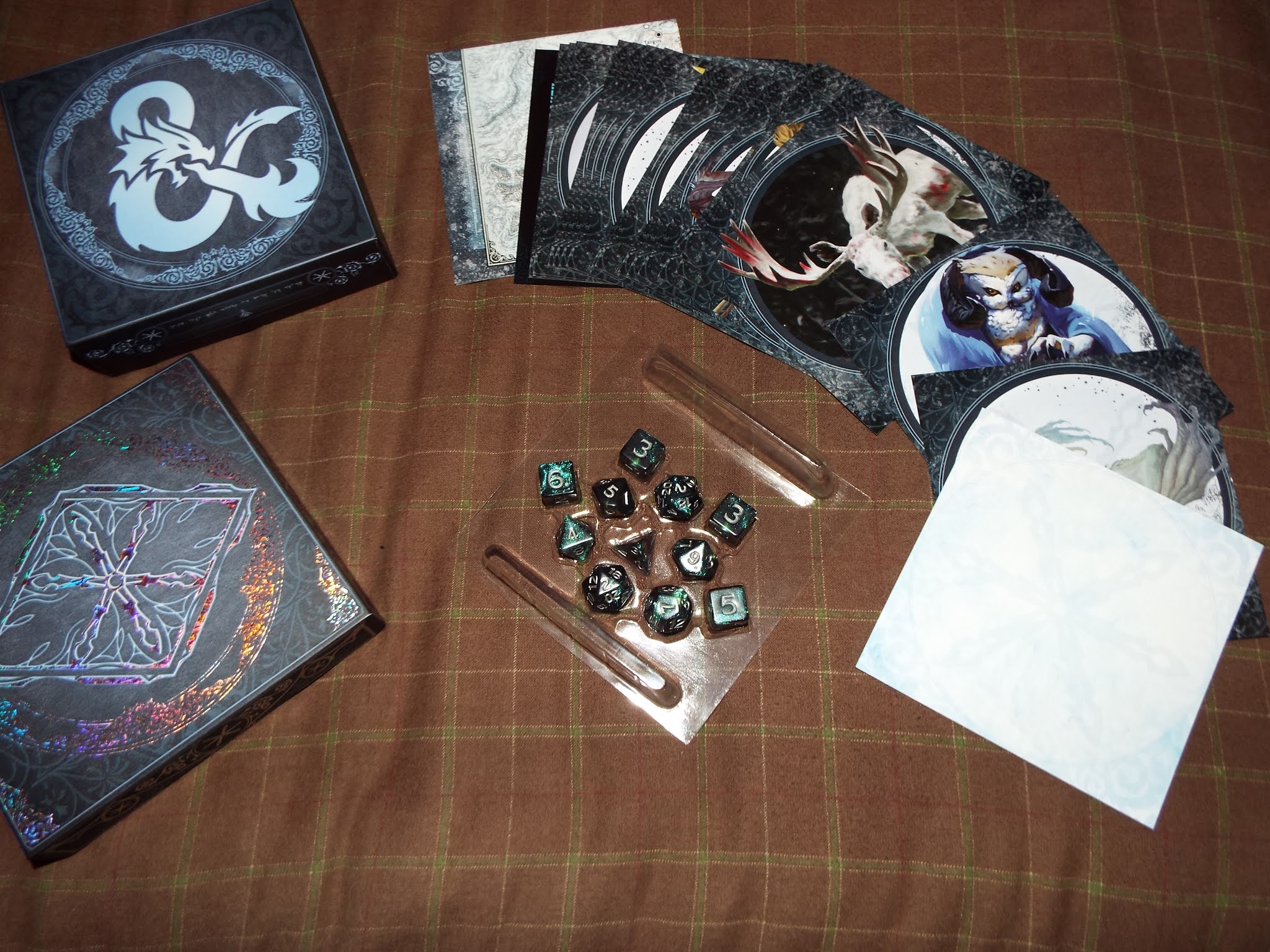
So, a large part of this will be duplicated from my previous reviews. That’s because this set is almost identical to the other sets.


Differences

  • The D20s are both normal size. I really do prefer it this way.

  • The map has a reverse side with maps of locations found on the big, overall area map. Also a good choice. It would be cool though if it was printed on small cards. That way you could place them down as they arrive, and also gives the Dungeon Master more freedom to choose which maps they want the players to see and when.

  • Everything is Icewind Dale themed, and meant to go with the adventure released along side, Icewind Dale: Rime of the Frostmaiden.


 Pros

  • Complete set, including 2 D20 (for advantage/disadvantage), 1 D12, 1 D10, 1 D8, 4 D6, 1 D4, 1 D100 (in 10 increments)

  • The additional of informational cards is a nice touch. They outline factions and enemies that can be found in Icewind Dale, all written from the perspective of Drizzt. They also provide a map. The added value here is great, I just wish they’d extent this further. Potion trackers, condition cards, that sort of thing.

  • The card box with inner felt is nice, and closes well.


Could Go Either Way

  • If you’re already an expert on the Forgotten Realms, and Icewind Dale in particular. the cards are going to be of no help to you. The map is still nice though.

  • The reverse side of the map has a reverse side that goes into more detail of certain locations found on the main map. It’d be nice to have these on cards though, so you could place them over the area when they’re there.

Cons

  • Similar to the other dice sets in this edition, this set can be a bit pricey compared to other dice manufacturers. These sets often go on sale making them more affordable, but the MSRP is rather high when you can buy sets for 10 bucks at your local game store. With sales though, it can be a far easier sale. That said, I’m happy to see that they added more to it than some previous sets they’ve released.


Everything below the image is duplicated from a previous review, which can be found here. I’ve done so for your convenience.


Rime Of The Frostmaiden Dice & Miscellany
Contents of the set: Dice, cards, map, and box.


Introduction

We got yet more dice, this time aimed at the Forgotten Realms. The set features 4 d6s, 2 d20, 1d12, 1d10, 1d8, 1d6, 1d4, and 1d100. To actually use the D100, you need to roll both the D10 and the D100. One gives you the one’s column, the other gives you the 10s. This is pretty standard. However, there’s more to the box than just the dice.


The Box

There’s a card box that comes with the set as well. The inside is nicely padded, and the artwork on the outside is very striking. I think it’s more of a display piece though, as I wouldn’t trust it around water, and I can see it being scratched up. Instead I think it belongs on a shelf. I’d suggest actually going to a game with a dice bag if you care about preserving the box. When you’re at home though that consideration goes away.


Cards

Included are a range of cards with descriptions of characters, factions and enemies found in Icewind Dale. Now these I like. You can keep them in the middle of the table for players to consult regularly, re-read quickly if there’s been a pretty serious break, or just put down on the table when meeting with a particular person as a visual aid, in in a particular area. Of course, if you’re not going to play in Icewind Dale this goes unused though.

Sunday, 6 September 2020

Scooby Doo Betrayal at Mystery Mansion Review

Review copy courtesy of Wizards of the Coast.


Board game for 3-5 players.


Pros:

  • Thematic gameplay that leads to fun situations. There are some very entertaining cards and there's quite a bit of fun to be had watching people fail at the events depicted. It very much helps to be able to get into the situation and enjoy the story that results. It's a Betrayal game after all.

  • Many new themed haunts, though not as many as some other versions of the game.

  • The Scooby Doo theme is given some attention, if you're into that part of it. This is mostly obviously seen in the haunts, and even the instruction manual got a change for this version. I think it's not a bad job at all. I'm not sure if it's as big a change as the D&D one though.


Could Go Either Way:

  • It's a Betrayal game. While there are changes, it is still very much the same system and if you didn't like the original it probably isn't enough for you to like this one. This goes for any variant. It’s best to think of it as a reskin.

  • While many of the cards do have art (much more than the Adventure System games), there are still many cards that are just descriptions.

  • The layout of the street level can get quite confused due to the combination of street and building tiles over the course of play. It makes for some interesting gameplay due to variety but often doesn't lead to the most sensible results.

  • It’s heavily dependant on luck. Go in expecting an hour or an hour and a half of luck centred high jinx. If you prefer more strategy and less luck, this might not be your thing.

Cons:

  • The chips/markers used to mark your stats stills aren't very good. They will cause damage to your character cards. You can kind of get away with not fully pushing them on, but that will obviously make it far easier to knock them off. This was a problem in the earlier version I reviewed. I’m a bit disappointed it wasn’t fixed in some way.

  • Wish the rules were provided online in PDF form or some other alternative in case of damage to the included ones.*

* Denotes nitpicking.


Scooby Doo Betray at Mystery Mansion Box
The box of Betrayal at Mystery Mansion.


Introduction

A new Scooby Doo movie is on the loose. What’s a fitting board game to tie in? Well, you could do much worse than Betrayal at House on the Hill. There’s the whole betrayer concept that doesn’t really fit, but that can be fixed with some writing. What do we get after all that? Well, this. So with that let’s go and jump right in. After all, execution matters.


It's Betrayal ... Again

I’ve already done a review of a version of Betrayal at House on the Hill. That one was D&D flavoured though. This is very similar in approach. The haunts and scenarios change a bit, and the characters are now characters from Scooby Doo, but otherwise the game is unchanged. This means if you have one of the other versions of the game, you’re unlikely to need another unless you think it’d appeal to a younger family member more. As a result, I’ll be repeating myself for completeness sake. That way you don’t have to read the other review if you don’t want to.


One thing I did notice is that the cards had more art and the box itself was made in a way to make it easier to store the pieces inside. I think both of these are good changes, but obviously by themselves they aren’t enough if you already own a different version of the game.


Betrayal at Mystery Mansion Pieces
Pieces for Betrayal at Mystery Mansion.


The Game Itself

The basis of the game should be familiar to anyone you read my review of the Baldur’s Gate version. If you’re reading this in order to get a feeling for what the game is like, you may want to look at that too. You explore a location by laying down tiles. So as you explore, the map is created. As you do, you draw cards which result in you picking up items, omens, running into bad situations, that sort of thing. Eventually, things change. One player is chosen to be the “traitor”, though given that it’s Scooby Doo it’s flavoured as them being captured/put out of commission by the villain of the week. The players then do their best to accomplish their conflicting goals.


Just like the other variants, luck is a major factor. Rolling dice, and drawing cards remain big parts of the game. This means sometimes someone will lose due to a series of bad rolls. As I said before “In my opinion it is one of those games where you need to lose yourself in the game and enjoy the story that is coming about over the course of play. Sometimes that story will be the heroes making an easy time of the villain. Sometimes it will basically be a slasher movie as the betrayer knocks out the other players one by one. It's just the nature of the game.”


There are 5 characters to choose from, each one being a main character from the show. This makes sense given it is Scooby Doo, but it is a decrease from the 12 in Betrayal at Baldur's Gate. Each character still has their own stats and their own abilty. This is still welcome, as it mixes things up on repeated playthroughs, which is a necessary part of the game. It really is meant to be played multiple times, and each time being different than the last.


A big consideration with so many flavours of the same game being out will be the tone you’re looking for. The original is a common favourite in my circles on Halloween. It sets the scene well, and really radiates that tone. This is somewhat close in that way compared to Betrayal at Baldur's Gate, which is more like an adventure, but not quite as horror movie-esque. Really, this would be a great one to play with kids, especially if they’re fans of the show.


The Game Pieces

The game pieces are in line with the quality of the previous game I reviewed, Betrayal at Baldur’s Gate. However, one place where this release is notably worse is in the player tokens. These here have a stand and cardboard cutout similar to some of the Pathfinder boxes. In the previous one I looked at, they had proper painted miniatures. I would have liked to see the characters modelled and painted.


As you should be used to with these types of board games, there are pages of tokens you need to push out before use. These include the tiles that will later make up the map you’re exploring. The material is card stock commonly found in these sorts of games. Just think Settlers of Catan or the D&D Adventure System (like Castle Ravenloft Board Game).


Betrayal at Mystery Mansion Storage
The box storage design.


The Art and Build Quality

The quality of the tiles is in line with the other versions of the game that I’ve seen. The art on things such as the cards is simple, but very fitting for what the card shows. This is important since they are on the smaller side compared to the Adventure System, so they need to look good, get the idea of the room across, but not be too busy. And on those points I believe it hits. Plenty of board games just have plain description on coloured cards, so I’m happy to see that this version has art on the cards. The one I previously reviewed was pure description.


The tokens are also what you’d expect. Art on simple backgrounds to ensure it stands out. This extends to other parts, such as the character cutouts. However, it still looks like the clips can damage these cutouts like they could in Betrayal At Baldur’s Gate, which is rather disappointing. Keep this in mind when using them. You could only partially push them on, or just leave them on the ground and lay it on top. You could also get lucky and have clips that don’t do that.


Where it dropped the ball in comparison to other versions of the game is the player miniatures. Well, there aren’t any. Instead it’s cardboard cutouts with a plastic platform. If they could’ve gotten some decent sculpts, I think it would’ve really added to the game. They wouldn’t be as reusable for D&D, but seeing sculpts on the board really does add something.


Reusable For D&D

Not really. There’s no miniatures, the tiles aren’t good for D&D maps. I guess you could use some of the cards, but the Adventure System board games are much better for that, as well as tiles for maps and they have miniatures too. Really, this is a board game you buy for the board game itself.


Price

The suggested US price is $50. This seems to be the same as the suggest price for the original Betrayal game, though depending on when you search you may be able to find it for cheaper.


What I felt was Missing

I’ve said it before, and I’ll say it again: I hope they put the rules online. These often get damages or lost, so having a printable backup without scanning my own book would be greatly appreciated.And if they have since I posted? Link me. I'd love to have a link to it right here. 

As well, there's fewer haunts in this one than the D&D version, and now there's also one less player due to all the players being part of the Scooby gang.


Summary

So it’s the same good old game that’s we’re accustomed to. There’s still a betrayer mechanic, at which point things switch from being about exploring the location to accomplishing a goal. The art is well done and consistently present throughout, even on the cards. We did lose out on miniatures like the D&D flavoured version though. All in all, it really depends on the flavour you want. Want the classic horror movie style theme? Not here. Want the D&D style adventure? Not here. Want the more relaxed Scooby Doo style, which will probably go over much better with the younger among us? Here we are.